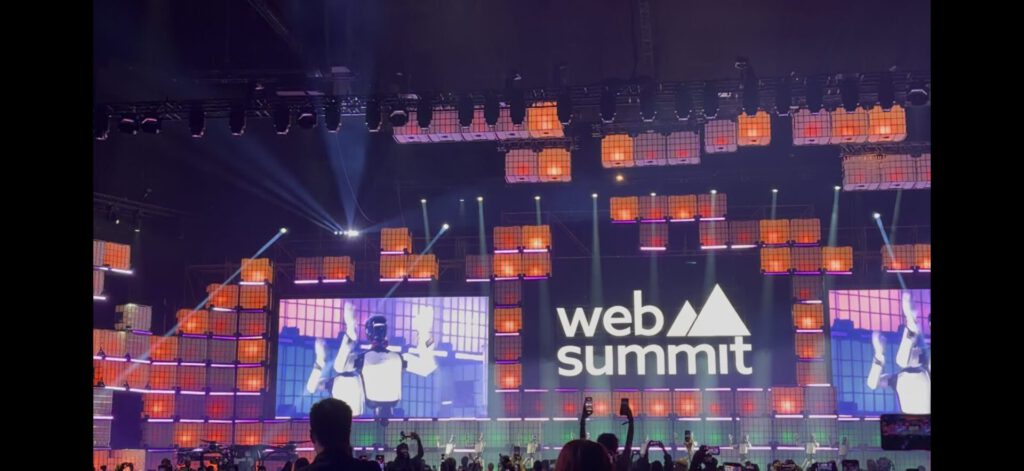
Nine years ago, Stephen Hawking stood on the Web Summit stage and warned of the dangers of artificial intelligence. In 2026, the tech conference in Lisbon resembles a garish American sales show. Yet it is reality itself that thwarts the grand promises.
The Sky Will Fall on Our Heads
Anyone walking through the exhibition halls of Lisbon’s Parque das Nações in November 2026 senses at once how profoundly the tech world has changed over the past nine years. When I last attended Web Summit in 2017, Stephen Hawking opened the conference via video link. He warned, with great urgency, that AI could be either the best or the worst thing ever to happen to humanity.
Despite its already considerable size, the event still carried a palpable spirit of start-up pioneering back then. Participants debated concrete web technologies, product development and European digital rules such as the upcoming General Data Protection Regulation.
In 2026, the event looks more like a heavily commercialised trade fair for business clients. More than 70,000 attendees from 164 countries made the trip, paying up to €1,595 for a ticket. The spectacle may take place in the middle of the European Union. Its tone, staging and balance of power, however, follow almost entirely the carnival barker logic of Silicon Valley.
For my work at the intersection of journalism, digital policy and strategic communication, the visit was nonetheless revealing, though not in the way the organisers had intended. I felt as though I were watching, live, as the unreflective AI hype began to crumble.
Geopolitical Double Standards Instead of European Sovereignty
The opening night on November 9 already showed how far the conference has drifted from a sober European culture of debate. On the main stage, nine humanoid robots from the Chinese manufacturer AgiBot danced. Web Summit founder Paddy Cosgrave celebrated them: “This year, without a doubt, we have the most important line-up of tech speakers ever. And they all come from China. Because Chinese companies are building more of our shared future than companies from anywhere else.”
Shortly afterwards, the Chinese manufacturer XPeng AeroHT rolled its “Land Aircraft Carrier” onto the stage. This is not a classic flying car but a six-wheeled van with a crewed drone stowed in the back. The drone could not take off, however, because the roof of the MEO Arena would not open.
At the same time, American representatives on other panels warned insistently of Chinese surveillance and data risks. In doing so, they consistently ignored the fact that the United States itself has held sweeping digital access powers since the Patriot Act and the NSA affair, and through laws such as the CLOUD Act.
Many speakers, by contrast, reflexively dismissed European rules as a brake on innovation. Portugal’s minister Gonçalo Matias did promise on stage that his country would implement AI “the European way”, combining sovereignty with openness. But amid the noise of American and Chinese showmanship, Europe looked above all like a regulated sales market, not an independent technological player.
The Interpreter Lesson: When Reality Catches Up with the Show
How fragile the narrative of the “unstoppable AI revolution” really is became clear, of all places, behind the scenes. On stage, speakers proclaimed that artificial intelligence would soon replace all knowledge work. The often overwrought moderation ridiculed sceptics. For live translation, though, the organisers themselves preferred to rely on human interpreters.
That was perhaps the most honest moment of the entire conference. When context, tone and accuracy matter in front of more than 1,500 journalists from around the world, not even the loudest tech evangelists trust their own tools.
Reddit CEO Jen Wong made a similar point on the main stage: in an internet flooded with AI-generated content, genuine conversations between real people take on an entirely new value. The message for newsrooms, companies and institutions is clear. Automation can speed up processes in the background. But where credibility, complex analysis and reputation count, human judgement remains irreplaceable.
Sobering Numbers Behind the Marketing Facade
Away from the flashy stage shows, the economic foundation of AI euphoria is crumbling. The facts are catching up with the marketing:
- More work, not less: According to Web Summit’s “State of the Industry” survey of almost 1,500 industry representatives, 60 percent of respondents say AI has so far increased their workload rather than reduced it.
- Meagre financial returns: Gartner estimates that around $2.7 trillion will flow into AI worldwide in 2026. Yet according to an analysis by KPMG, only seven percent of companies have so far achieved a reliable financial return.
- The cost trap: List prices per token have fallen. Modern models capable of complex reasoning, however, require 4.5 times as many computational steps in the background. As a result, the actual cost per completed task has risen by 93 percent. At the same time, heavily indebted AI companies such as OpenAI, which is expected to lose around $14 billion in 2026, have to scale back their subsidies ahead of planned IPOs.
- Concentrated risks in the infrastructure: While the conference was under way, an internal investigation into Nvidia CEO Jensen Huang over allegedly circumvented export controls rattled the stock markets. Within two days, around $470 billion in market value evaporated. Even Cloudflare CEO Matthew Prince warned on stage against mere financial engineering and predicted a harsh market shakeout.
What This Means for Editorial Strategy and Communication
For anyone who shapes content, media and public debate strategically, this development is good news. That holds especially true for search engines and AI answer engines. On one of Web Summit’s workshop stages, someone said something remarkable: “AI knows everything that’s on the internet. But it doesn’t know what it feels like to fly.”
The “AI” label has had its day as a tool for attention and sales. Audiences, and increasingly algorithms too, are saturated with interchangeable, machine-generated text. Anyone who wants to stay visible and build trust needs the opposite of the Silicon Valley show: a sober European culture of debate, solid original research, transparent analysis and an unmistakably human signature.
From Wet Summit to a New Seriousness
On Wednesday, Storm Charles forced the complete cancellation of the conference’s second day. There was no refund for expensive tickets or start-up booths. Meanwhile, the heavy rain dripped through the leaking roof of the FIL. Online, visitors promptly rechristened the event “Wet Summit”.
The planned talk by the Council of Europe’s Commissioner for Human Rights, Michael O’Flaherty, and a Vatican AI ethicist on a human-centred framework for AI also fell victim to the storm. It was the perfect image of an industry whose glossy marketing facade is beginning to crack.
The age of blind tech slogans is drawing to a close. What counts now, once again, is editorial depth, a clear stance and stories that hold up against reality.